









Basket Random
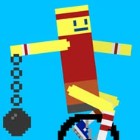
Basket Random hands each side a pair of lanky, rubber-limbed players and exactly one key to control both of them. Press it and they leap, flail their arms and hope the ball lands somewhere useful. Every point resets the court with a new surprise, so the match you started is rarely the match you finish.
One Key, Two Very Floppy Athletes
There is no dribble button, no pass button and no shot meter. A single press makes both of your players hop forward and swing upward, and everything else comes from momentum and collisions. Grabbing the ball, knocking it loose and putting it through the hoop all happen through that same jump, timed well or badly.
The trick is restraint. Mashing keeps your players airborne and useless, while one patient press at the right moment wins the scramble under the rim.
A shot counts when the player holding the ball leaps close to the basket while facing it. Newcomers usually figure that out after a few accidental baskets, and from then on the match becomes a duel of timing rather than speed.
Why Every Point Feels New in Basket Random
Between points, the setup reshuffles. One round might give everyone giant heads, the next a slippery floor, another a ball that bounces like a beach toy. Players can shrink or stretch, and the arena itself can change surface.
That shuffle means memorized patterns do not last. What worked on a normal court can send your players skating past the hoop on ice.
Matches usually run to five points, which keeps comebacks possible. A bad streak on one odd court can be erased two points later when the dice roll in your favor.
Couch Rivalries on a Single Keyboard
The setup shines when two people sit side by side, each with one key. Arguments, laughter and rematch demands start almost immediately, because losses rarely feel fully fair and wins rarely feel fully earned.
Playing the computer works as practice. It teaches when to jump and when to wait without the pressure of a friend gloating next to you.
Some competitive players dislike how much luck the shuffle adds. Casual pairs tend to see that same luck as the whole point.
Small Habits That Win Matches
Wait for the ball to drop rather than jumping at it early. Players who leap first often sail past it, leaving an easy grab for the opponent.
Keep one player near your own basket when defending. Because both of your athletes jump together, whoever stays deep can swat shots that the other misses.
On strange courts, slow your rhythm. Ice, tiny players and huge balls all change the arc of a jump, and a calm single press handles that better than panic.
Basket Random Courts Worth Remembering
Ice floors are the classic chaos court. Players slide past the ball, crash into each other and sometimes score by accident, so a lighter touch on the key pays off there.
Giant players change the rhythm in another way. Their long arms reach the hoop easily, but they land slowly, which leaves room for a quick counter-jump from the other side.
Odd balls round out the list. Bouncy or oversized balls behave unpredictably near the rim, and patience usually beats aggression when one appears.
How many keys does each side use?
Just one. Each press makes both of your players jump and swing together.
How long is a match?
Most matches go to five points. That short length keeps rematches quick and comebacks realistic.
Why did my players suddenly get huge?
The court reshuffles between points. Player size, ball type and floor surface can all change at random.
Basket Random squeezes a whole basketball game into one key and two wobbling players. The reshuffled courts, oversized heads and slippery floors make sure no two points ever play out the same way.