

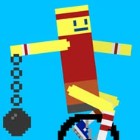










Bread & Fred
What happens when two penguins are tied together by a single rope and asked to climb a frozen mountain? Bread & Fred answers that question with one of the most stressful and funniest co-op climbs around, where every swing, slip and fall depends on the person at the other end of the rope.
| Genre | Co-op physics climbing platformer |
|---|---|
| Characters | Bread and Fred, two penguins |
| Core mechanic | Climbing while tied together by a rope |
| Setting | A snowy mountain |
| Players | Two-player co-op or solo with both penguins |
The Rope That Holds Everything Together
Bread and Fred are connected, and that rope is both lifeline and curse. When one penguin falls, the other can anchor and pull them back up, but a careless jump can drag both down a long way. The core idea is simple: one moves while the other holds, then they swap.
That rhythm sounds easy until both players get impatient at the same time. Most big falls start with two penguins jumping at once.
Swinging is the most important technique. A penguin hanging from a ledge can be swung by a partner to reach platforms that are impossible to jump to, and learning the timing of those swings is where most of the skill lives.
Climbing Higher in Bread & Fred
The mountain gets steeper and stranger as you climb. Early ledges are wide and forgiving, while later sections bring slippery ice, narrow footholds and long drops that can undo several minutes of progress in one moment.
- Agree on who anchors and who moves before each jump.
- Never jump while your partner is mid-air.
- Use swings to cover gaps instead of risky leaps.
- Talk constantly, especially near long drops.
Players who enjoy rage climbers will recognize the feeling of losing a big chunk of height. Still, having a partner turns that frustration into shared laughter more often than anger.
The higher you get, the more those habits matter. That is because a single rushed jump near the summit can cost far more height than the same mistake on the first slopes.
Solo Play and Honest Frustrations
The game can be played alone by controlling both penguins, which turns it into a coordination puzzle for one brain. It is harder in some ways and more relaxing in others, since nobody else can make a mistake for you.
Falls are the main point of debate. Some players love the tension of losing progress, while others find long drops too punishing.
Couples and close friends often call it a relationship test. That is because it rewards patience, clear communication and the ability to laugh when your partner sends you both back to the bottom.
Bread & Fred With a Partner Versus Alone
Playing with a partner turns every ledge into a conversation. You negotiate who goes first, argue about whether a swing is safe and celebrate together when a long section finally clears. That social layer is the heart of the experience and the reason so many streamers picked it up.
Playing alone feels more like a puzzle. Controlling both penguins means planning each move in advance, and the rope becomes a tool you manage rather than a person you trust.
Many players try both. A solo run teaches the mechanics without pressure, and a co-op run afterwards becomes much smoother because you already understand how the rope behaves on ice.
Can you play Bread & Fred solo?
Yes, you can control both penguins yourself. It changes the challenge into a careful coordination puzzle rather than a communication test.
How does the rope work?
Bread and Fred are tied together, so one can anchor while the other climbs or swings. Falls by one penguin pull on the other, which is why timing matters.
Is it a rage game?
It has rage-game moments, especially on long drops. Still, the co-op focus keeps it more playful than most solo climbers.
Bread & Fred turns a snowy mountain into a test of trust. Bread and Fred only reach the top when both players learn to anchor, swing and climb in rhythm on the same rope.